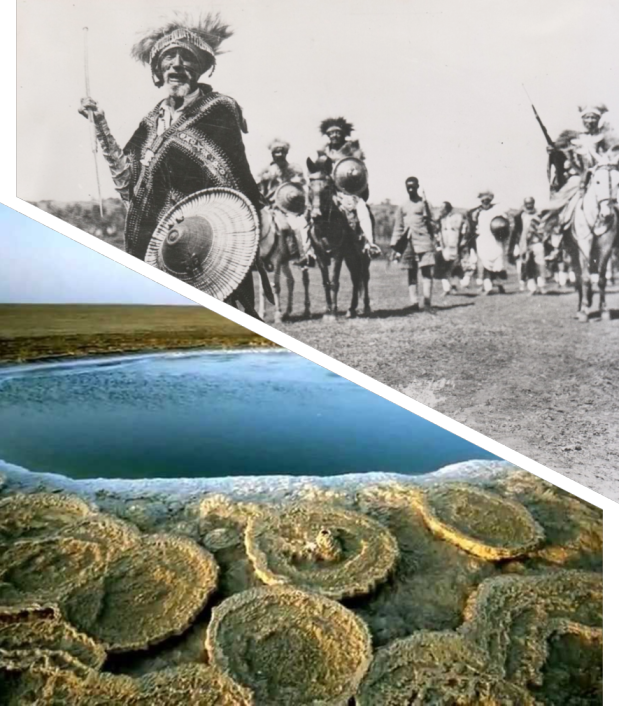

Ethiopia, located in the Horn of Africa, is one of the world’s most ancient and culturally distinct nations. Known as the Cradle of Humanity, it has contributed greatly to our understanding of early human evolution and civilization.
Fossils discovered in places like the Afar Triangle and Lower Omo Valley including Lucy (Australopithecus afarensis, over 3 million years old) and Idaltu (160,000 years old)—prove that Homo sapiens first evolved in Ethiopia. These discoveries confirm Ethiopia’s central role in the origin of mankind.
Historically, Ethiopia was known as Abyssinia and was home to the Kingdom of Aksum, one of the world’s earliest Christian civilizations. The country is also believed to be part of the ancient Land of Punt, a region famous in Egyptian records as a land of wealth, gold, incense, and exotic animals. Many historians and archaeologists associate Ethiopia and the Horn of Africa with this mysterious and prosperous civilization, showing that Ethiopia was a center of international trade and culture thousands of years ago.
Ethiopia also stands out for having its own alphabet, called Fidel or Ge’ez script, used in languages such as Amharic and Tigrinya. It is one of the world’s oldest alphabets still in use today, made up of over 200 characters combining consonants and vowels.
The Ethiopian calendar is unique as well, consisting of 13 months and being about 7–8 years behind the Gregorian calendar. Ethiopia is also the birthplace of coffee, discovered in the forests of Kaffa, where the bean still plays a central role in daily life and social gatherings.
Ethiopia’s Bible, written in Ge’ez, contains more books than any other Christian canon and reflects the deep roots of the Ethiopian Orthodox Church. The country also claims to house the Ark of the Covenant in the ancient city of Axum, making it a place of great spiritual significance.
With over 84 ethnic groups, Ethiopia is a land of rich cultural diversity. Its geography—from high mountains to the Great Rift Valley—is the source of major African rivers, earning it the name "Water Tower of Africa."
In conclusion, Ethiopia is not only where human life began but also where ancient trade, script, spirituality, and tradition continue to thrive. Its links to Punt, its alphabet, calendar, and biblical heritage make it a truly unique and foundational nation in human history.
To visit Ethiopia is to walk through history, to witness nature in its wildest forms, and to connect with people whose warmth and resilience will stay with you long after you’ve left. Whether you're a history buff, culture seeker, photographer, or adventure traveler — Ethiopia offers a journey that will challenge your senses and enrich your soul.

Ethiopia stands as a deeply spiritual land where faith is intricately woven into the fabric of everyday life. As the heartland of Ethiopian Orthodox Christianity, Islam, and a tapestry of traditional African religions, the country radiates a reverence for the sacred in every corner from ancient monastic caves to bustling urban churches and mosques. What sets Ethiopia apart is the way spirituality is not just practiced but profoundly lived.
Ethiopia is a feast for the senses and nowhere is that more evident than in its rich culinary and coffee traditions. As the birthplace of coffee, Ethiopia has elevated its preparation into an art form. The traditional coffee ceremony is a central part of Ethiopian hospitality a slow, elegant ritual that involves roasting green coffee beans over an open flame, grinding them by hand, and brewing them in a clay pot called a jebena. Served in three rounds (abol, tona, bereka), each cup symbolizes connection, respect, and community. Conversations deepen and relationships are nourished as the aromatic steam curls into the air.
The food is equally rooted in sharing and tradition. Injera, the spongy, sour flatbread made from teff, is the staple of every meal and also serves as the utensil pieces are torn off and used to scoop up delicious stews and vegetables.
Unlike any other African nation, Ethiopia was never colonized, giving it a truly unique identity. Its own alphabet (Ge'ez script), calendar, time system, and religious heritage set it apart. With over 80 ethnic groups and languages, the cultural diversity is immense — from the vibrant highland Christian traditions to the rich customs of the Omo Valley tribes.
From the snow-capped peaks of the Simien Mountains to the lunar landscapes of the Danakil Depression (one of the hottest and lowest places on Earth), Ethiopia offers an array of natural wonders. Trekking, wildlife watching, birding, and volcano hiking await adventure lovers. It's a haven for anyone drawn to raw, untamed beauty.